
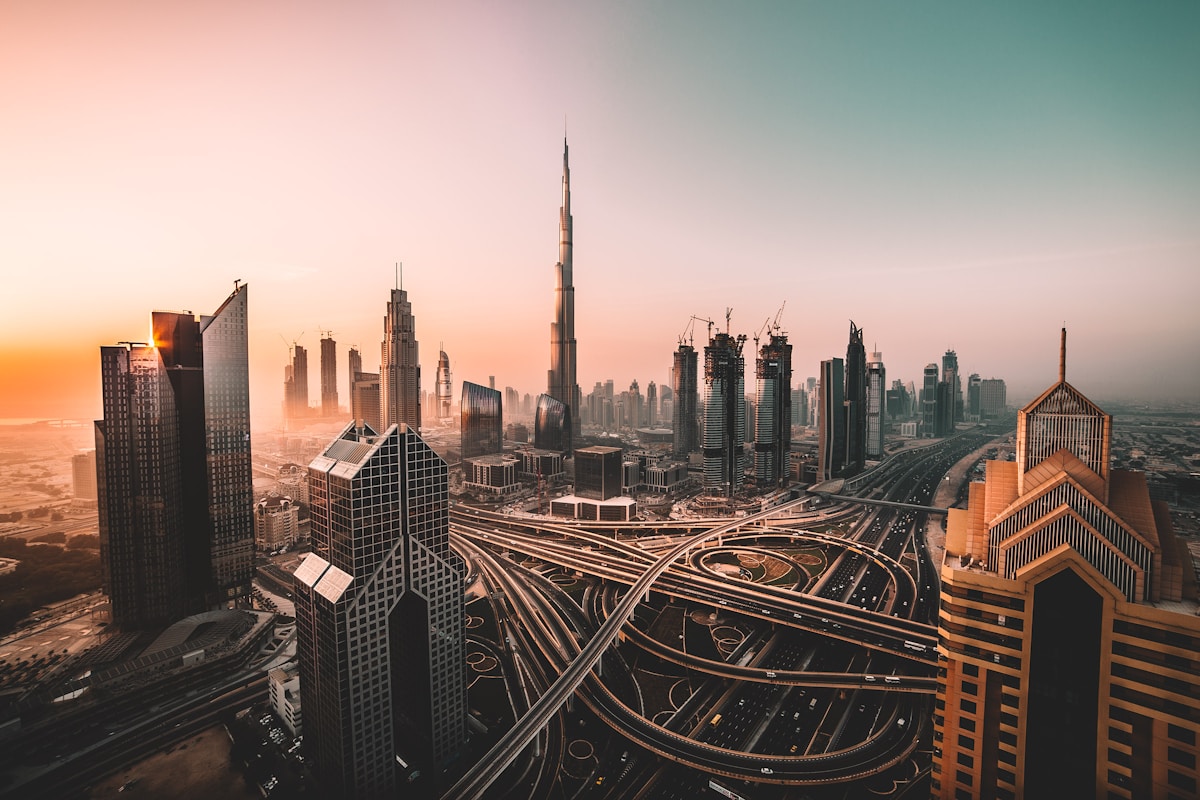
In short: The Dubai Metro Blue Line is a 30 km, 14-station line costing AED 20.5 billion, awarded to a MAPA–LIMAK–CRRC consortium and scheduled to begin commercial operations on 9 September 2029. It runs in two branches — a 21 km, 10-station route from the Creek interchange at Al Jaddaf out to Academic City, and a 9 km, 4-station route from Centrepoint at Al Rashidiya — meeting at an underground interchange at International City 1. For property buyers the honest answer is narrower than the headlines: Dubai's one serious dataset on metro proximity, CBRE's 2023 study of about 74,000 sales transactions, found homes within a 15-minute walk of a Red Line station grew 26.7% from 2010 to 2022 against 24.1% city-wide — a real but modest 2.6 percentage-point edge, and the strongest band was 10 to 15 minutes from a station, not the one next to it.
Key numbers
- AED 20.5 billion — total contract value, awarded by Dubai's Roads and Transport Authority (RTA) to a consortium of MAPA and LIMAK (Türkiye, civil works) with CRRC (China, rail systems), RTA announcement, 19 December 2024.
- 30 km, 14 stations — 15.5 km underground and 14.5 km elevated, per the same RTA announcement. RTA's June 2025 project page describes the station mix as 9 elevated and 5 underground.
- 9 September 2029 — scheduled start of commercial operations (9/9/2029), RTA; twenty years after the Red Line opened on 9 September 2009.
- 21 km / 10 stations and 9 km / 4 stations — the two branches, joined at the International City 1 interchange, which RTA describes as its largest underground station at over 44,000 m² with capacity for about 350,000 passengers a day (RTA, 9 June 2025).
- Over 200,000 riders a day by 2030, rising to 320,000 by 2040 — RTA forecast; line capacity is given as 46,000 passengers per hour per direction with trains roughly every two minutes.
- About 1 million residents across nine districts by 2040, and a 20% reduction in congestion on the corridors served — RTA projections, 9 June 2025.
- +26.7% versus +24.1% — price growth for homes within a 15-minute walk of a Red Line station against the Dubai average, Q1 2010 to Q4 2022, CBRE The Dubai Metro Report 2023 (published 14 April 2023), based on roughly 74,000 sales transactions and 112,000 Ejari rental contracts.
- 20% of construction complete, with 30% targeted by end-2026 — stated when Sheikh Mohammed bin Rashid Al Maktoum inaugurated tunnelling works, Dubai Media Office, 3 May 2026, with more than 10,000 workers deployed.
What RTA has confirmed — and what it has not
The line's spine is settled. RTA's December 2024 contract announcement and its June 2025 project page agree on 30 km, 14 stations, the two-branch structure, the three interchanges and the 9/9/2029 target. Tunnelling began in May 2026 with the tunnel boring machine Al Wugeisha working beneath International City; Gulf News reported on 29 July 2026 that it was operating at roughly 35 metres below street level with about 1,200 metres excavated.
Two things are commonly reported as settled and are not.
Station names. Only one has been confirmed: the Dubai Creek Harbour station will be called Emaar Properties Station, under a naming-rights arrangement running at least ten years from the 2029 opening. RTA has published station locations; Time Out Dubai reported on 16 October 2026 that the authority "will eventually announce the names that each station will bear." Of the 14, RTA has publicly identified twelve locations; two remain undetailed.
The airport. The Blue Line does not have a station inside Dubai International Airport. RTA's figure is a roughly 20-minute airport journey, delivered by interchange — Centrepoint on the Red Line sits at Al Rashidiya, two stops from Terminal 3. Whether the Blue Line will eventually tie into the existing terminal stations or a new one has not been stated.
There is also a minor inconsistency worth naming: RTA's June 2025 page gives 9 elevated and 5 underground stations, while the May 2026 Media Office release describes seven elevated, four underground and three interchanges. These are almost certainly two ways of counting the same 14 stations, with interchanges split out separately in one and folded in to the other.
The 14 stations, area by area
Station names below are the area names RTA has published, not final branding. "Branch" refers to the 21 km Creek route or the 9 km Centrepoint route.
| Station (area) | Branch | What is there now | Who it serves | Interchange |
|---|---|---|---|---|
| Creek (Al Jaddaf) | Creek, 21 km | Existing Green Line terminus, hotels, hospitals, mid-rise residential, Dubai Festival City across the creek | Hospital and hotel staff, Al Jaddaf residents, Green Line commuters | Yes — Green Line |
| Dubai Festival City | Creek, 21 km | Festival City Mall, Al-Futtaim offices, hotels, Al Badia residential and golf | Retail and hospitality workforce, office tenants, Festival City residents | No |
| Dubai Creek Harbour (Emaar Properties Station) | Creek, 21 km | Emaar's waterfront masterplan, largely delivered in phases, with substantial off-plan pipeline | Owner-occupiers and tenants in a community built for the station | No |
| Ras Al Khor Industrial Area | Creek, 21 km | Warehouses, workshops, the vehicle and aluminium trade, labour accommodation, the wildlife sanctuary | Industrial workforce, last-mile and trade operators | No |
| International City 1 | Both — junction | Dragon Mart, high-density affordable apartments, Phase 2 and 3 development | Dubai's largest concentration of affordable apartment tenants | Yes — branch junction, largest underground station |
| International City 2 | Creek, 21 km | Newer International City phases, Warsan residential | Affordable-segment tenants, newer building stock | No |
| International City 3 | Creek, 21 km | Developing residential plots, Warsan edge | Future residents of a still-forming district | No |
| Dubai Silicon Oasis | Creek, 21 km | Free-zone tech and SME offices, residential towers, schools | SME staff, tech tenants, families on mid-market rents | No |
| Dubai Academic City | Creek, 21 km — terminus | University campuses, student housing, academic institutions | Students and faculty; the most commute-dependent group on the line | No |
| Centrepoint (Al Rashidiya) | Centrepoint, 9 km | Existing Red Line terminus, Al Rashidiya and Al Nahda residential, airport two stops away | Airport-adjacent workforce, Red Line commuters, Deira-side residents | Yes — Red Line |
| Mirdif | Centrepoint, 9 km | Mirdif City Centre, low-rise villas and Mirdif 35 apartments, schools | Families currently entirely car-dependent | No |
| Al Warqa | Centrepoint, 9 km | Villa districts, Al Warqa 1–5, local retail | Villa tenants and owner-occupiers with no rail access today | No |
| Two further locations | Not publicly detailed | — | — | Not stated |
Dubai Creek Harbour is the one station on this list the market has already studied in depth. If that is your specific question, the Creek Harbour-specific read on the Blue Line covers it, alongside Creek Harbour's existing road and airport connectivity. This article deliberately stays on the rest of the corridor.
What the evidence actually says about metro proximity and Dubai property values
This is where most Blue Line commentary stops being useful. The standard brokerage line is a fixed uplift percentage for anything near a station. Dubai does have one serious dataset, and it does not support that framing.
CBRE's The Dubai Metro Report 2023, published 14 April 2023, examined more than 300 residential and mixed-use properties within a 15-minute walk of Red Line stations, using about 74,000 sales transactions from Q1 2010 to Q4 2022 and about 112,000 Ejari rental contracts from Q1 2018 to Q4 2022.
| Metric | Within 15-min walk | Dubai overall | Gap |
|---|---|---|---|
| Price growth, Q1 2010 – Q4 2022 | +26.7% | +24.1% | +2.6 pp |
| Rent growth, Q1 2018 – Q4 2022 | +5.7% | −4.1% | +9.8 pp |
The sales gap is the honest headline: 2.6 percentage points over twelve years. That is a real edge, but it is nothing like the uplift the marketing language implies. The rental gap is much wider — rents near stations rose while the city average fell — which fits the mechanism better. A station changes who can live in a building without a car, and tenants reprice faster than owners.
The counter-intuitive part: the 10–15 minute band outperformed
Broken down by walking band, CBRE found:
| Walking distance to station | Price growth 2010–2022 | Rent growth 2018–2022 |
|---|---|---|
| 0–5 minutes | +35.8% | +0.9% |
| 5–10 minutes | +0.2% | −0.5% |
| 10–15 minutes | +43.8% | +11.7% |
The band immediately adjacent to a station was not the best performer on either measure. The 10 to 15-minute band led both. CBRE's own conclusion is the one to carry forward: proximity helps "only if the development encompasses the right amenities and suitable urban infrastructure." By area, within 15 minutes of a station, CBRE recorded price growth of 77% in Barsha Heights, 50.1% in Jumeirah Beach Residence, 47.4% in Downtown, 33.1% in Dubai Marina and 25.7% in Jebel Ali Free Zone (reported by Khaleej Times, 18 April 2023) — a spread wide enough to prove that the station was never the main variable.
Why "up to 25%" is a projection, not a finding
RTA's own June 2025 project page states that land and property values near Blue Line stations are "expected to rise by up to 25%", alongside a benefit-cost ratio of 2.60 and benefits above AED 56.5 billion by 2040. That is an official projection from the authority building the line, not an observed outcome, and it is not derived from the CBRE transaction record. Treat it as a stated objective. No published study specific to the Blue Line corridor exists yet, for the obvious reason that the line does not exist yet.
Reasoning, not data — labelled as such. Where the numbers run out, the mechanism is still worth stating plainly. A metro station widens the tenant pool to households that cannot or will not run a car, which matters most in the affordable segment where a car is a meaningful share of monthly cost. It compresses commute time to employment nodes, which is what a tenant is actually buying. It gives a building access to transport without adding to its service charge, unlike a pool or a gym. And over time it softens parking demand, which can change how a developer uses podium space. None of that produces a number. All of it is more defensible than a percentage nobody can source.
The corridor's least-discussed station: Ras Al Khor Industrial Area
Every Blue Line article covers Creek Harbour. Almost none covers the station one stop away.
Ras Al Khor Industrial Area is warehousing, workshops, the vehicle and aluminium trade, and labour accommodation. Its operating constraint is not rent — it is workforce movement. Staff arrive by company bus or shared transport on fixed schedules, and shift patterns are built around that. A metro station changes the arithmetic: it introduces a transport option that runs on its own timetable rather than the operator's, which affects staff retention, overtime flexibility, and the practical catchment from which a tenant can recruit.
For warehouse owners and occupiers that is a genuine operating variable, not a sentiment story — and it is one of the few places on this corridor where a 2029 station has an effect you can model before it opens. It sits alongside the road-access questions already reshaping the zone, covered in Al Quoz and Ras Al Khor last-mile warehousing and in the wider map of Dubai's warehouse zones and worker housing. The honest caveat: industrial rents in Dubai are driven primarily by supply, power and road access, and a passenger metro station is a secondary input to all three.
The areas the market has barely priced
Nine of the fourteen stations sit in districts that get very little investment coverage. Two data points worth holding:
Bayut's Dubai Rental Market Report H1 2026 put average asking rents for International City apartments at AED 60,000 a year — AED 41,000 for a studio, AED 61,000 for a one-bedroom and AED 82,000 for a two-bedroom — with rental growth of 4.25%, driven mainly by studios and one-bedrooms. International City was one of three areas, with Al Nahda and Deira, that retained their popularity in the affordable apartment segment. The same report put average asking rents for Mirdif villas at AED 159,000 a year, with 0.56% growth in the three-bedroom segment.
That combination — three Blue Line stations landing in Dubai's single largest affordable apartment cluster, and one landing in a villa district with no rail access today — is the structurally interesting part of this line. It is also where the published yields sit; see published yields by area for that picture. Separately, the line is planned to interchange with the national rail network, which makes Etihad Rail's passenger stations the intercity layer above this one.
What this means for you
If you are an end-user buyer. You are the reader for whom this is simplest. A station near your home in 2029 is a real improvement in daily life, and if you intend to hold for ten years you will capture whatever uplift arrives without needing to time it. Buy the home and the community on their current merits — school run, commute, building quality, service charge — and treat the station as a bonus you did not pay a premium for. If a seller is asking you to pay today for a 2029 station, you are funding their thesis.
If you are a rental investor. CBRE's rent data is the part of the record that supports you: rents near stations rose 5.7% from 2018 to 2022 while the city average fell 4.1%. The mechanism is a wider tenant pool, and it is strongest in the affordable segment, which is exactly what the International City and Al Warqa stations serve. Two cautions. First, the premium showed up at 10 to 15 minutes from a station as much as at the door, so paying for the closest building is not obviously the trade. Second, nothing about a 2029 station protects you from the supply cycle between now and then. Underwrite on today's achievable rent, not on 2029's.
If you are a business owner near a station. Your gain is in staffing and footfall, not in asset value. A retailer or clinic within walking distance of a station gains a catchment that does not need parking. A warehouse or workshop operator gains a recruitment radius and shift flexibility. Both are worth planning for now in lease terms — length, renewal options, and whether your current premises will still suit a business whose staff arrive differently in 2029. What you should not do is pay a rent premium today for 2029 footfall, because the construction years come first.
The honest reading of the risks
The timeline is nearly three years out, and infrastructure timelines slip. RTA has hit its stated milestones so far — 10% within five months of the June 2025 groundbreaking, 20% at the May 2026 tunnelling launch, 30% targeted by end-2026 — which is a good record, and 9/9/2029 is a date with symbolic weight the authority will work hard to protect. But a 15.5 km tunnelled line with a 1,300-metre creek crossing has real delivery risk, and any plan that only works if the line opens exactly on time is not a plan.
The announcement is already public, so it is not an edge. The route was approved in 2023, the contract awarded in December 2024, the map released in 2025 and tunnelling inaugurated in May 2026. Every seller on this corridor knows. Whatever the market is willing to pay for a 2029 station is, to a large extent, already in the asking price. The investor's question is not "will the metro help?" — it is "am I paying more than the help is worth, three years early?" On CBRE's twelve-year evidence, the realistic answer for a non-prime location is that the help is worth less than most sellers believe.
Construction disruption comes before the benefit. RTA has described eleven traffic diversions in place with more than ten more planned, excavation of over 400,000 cubic metres at the International City station sites, and work spread across twelve sites. For a tenant, that means noise, dust and diverted access through 2027 and 2028. For a landlord, it means those are the years when a nearby unit is harder to let, not easier. That is a cash-flow problem with a three-year duration, and it lands before any uplift does.
Who this does not suit. Anyone who needs to exit inside three years. Anyone buying a specific unit mainly because a station is planned nearby, rather than because the unit and area stand on their own. And anyone being shown a fixed percentage uplift as a reason to transact today — that number has no sourceable basis in the Dubai record.
What is still unclear
- Final station names. Only Emaar Properties Station is confirmed. RTA has released locations and has said names will follow.
- Two of the fourteen locations. RTA has publicly identified twelve; the remaining two have not been detailed.
- Maximum tunnel depth. The 15.5 km underground figure is official. A specific maximum depth is not published; the only measured figure found is roughly 35 metres beneath International City, reported by Gulf News on 29 July 2026. Claims of greater depths circulate without an official source.
- How the airport link will work physically — whether via the existing Terminal 1 and Terminal 3 stations or a new one.
- Fares and service patterns. No fare structure or through-running pattern between the branches has been published.
- Station mix. RTA's two public descriptions count elevated and underground stations differently, as set out above.
- Any Blue Line-specific property study. None exists. The CBRE work is Red Line only and ends in 2022.
FAQ
When does the Dubai Metro Blue Line open? Commercial operations are scheduled to begin on 9 September 2029, per RTA — twenty years to the day after the Red Line opened in 2009. As of the May 2026 tunnelling launch the project was 20% complete, with 30% targeted by the end of 2026.
How many stations does the Blue Line have, and what are they called? Fourteen, across two branches. RTA has published twelve locations: Creek (Al Jaddaf), Dubai Festival City, Dubai Creek Harbour, Ras Al Khor Industrial Area, International City 1, 2 and 3, Dubai Silicon Oasis, Dubai Academic City, Centrepoint (Al Rashidiya), Mirdif and Al Warqa. Only one name is final — Emaar Properties Station at Dubai Creek Harbour.
Does the Blue Line go to Dubai International Airport? Not directly. There is no Blue Line station inside the airport. RTA's stated journey time of about 20 minutes is achieved by interchanging at Centrepoint (Al Rashidiya) onto the Red Line, which serves Terminals 1 and 3.
Do properties near Dubai Metro stations really sell for more? CBRE's 2023 study of about 74,000 transactions found homes within a 15-minute walk of a Red Line station grew 26.7% between 2010 and 2022 against 24.1% city-wide — a 2.6 percentage-point edge. The rental effect was larger: +5.7% near stations from 2018 to 2022 against −4.1% city-wide. There is no credible Dubai study supporting a fixed uplift percentage.
Is it worth buying on the Blue Line corridor now, before 2029? It depends on whether the property works without the station. The route has been public since 2023 and the contract since December 2024, so the expectation is already in asking prices. The case for buying now is the asset and the area; the station is an additional reason, not a substitute for the first two.
What does the Blue Line mean for warehouses in Ras Al Khor? The practical effect is on workforce movement rather than on rent. A station gives industrial employers a transport option on a public timetable rather than a company bus schedule, which affects recruitment radius and shift flexibility. Industrial rents in Dubai remain driven mainly by supply, power and road access.
How much is the Blue Line costing, and who is building it? AED 20.5 billion. RTA awarded the contract in December 2024 to a consortium of MAPA and LIMAK of Türkiye, handling civil works, with CRRC of China on rail systems.
Verify before you act
Metro alignments, station locations, names and dates are all subject to change, and RTA is the only authority whose statement counts. Before you make a decision that depends on any figure here, confirm it against the live RTA project pages and the Dubai Media Office releases, and confirm any rent or price figure against the current source report rather than this article. Everything above was verified on 4 November 2026; a project running to 2029 will be restated several times before it opens.
If you are weighing a purchase, a lease, or a warehouse relocation anywhere on this corridor, the useful next step is a strategic consultation — a diagnostic of your own position, holding period and cash flow against what the corridor can and cannot be expected to deliver by 2029. That is a different conversation from being shown a station on a map.
Sources
- Roads and Transport Authority (RTA) — "Announcing the Awarding of Dubai Metro Blue Line Project" (AED 20.5bn contract to MAPA, LIMAK and CRRC; 30 km; 15.5 km underground; 14 stations; two routes; interchanges; ridership; 9/9/2029; 19 December 2024) — https://www.rta.ae/wps/portal/rta/ae/home/news-and-media/all-news/NewsDetails/announcing-the-awarding-of-dubai-metro-blue-line-project (accessed 2026-11-04)
- Roads and Transport Authority (RTA) — "Mohammed bin Rashid lays foundation stone for Dubai Metro Blue Line" (9 elevated and 5 underground stations; International City 1 interchange 44,000+ m² and 350,000 passengers/day; Emaar Properties Station 74 m and 11,000 m²; 1,300 m creek bridge; Al Ruwayah 3 depot; ~1 million residents across nine districts by 2040; 20% congestion reduction; ~20-minute airport connection; property values "expected to rise by up to 25%"; benefit-cost ratio 2.60 and AED 56.5bn benefits by 2040; 9 June 2025) — https://www.rta.ae/wps/portal/rta/ae/home/news-and-media/all-news/NewsDetails/mohammed-bin-rashid-lays-foundation-stone-for-dubai-metro-blue-line (accessed 2026-11-04)
- Dubai Media Office — "Mohammed bin Rashid launches tunnelling works for the Dubai Metro Blue Line tunnels" (20% complete, 30% targeted by end-2026; more than 10,000 workers; branch lengths and station counts; 15.5 km underground and 14.5 km above ground; 3 May 2026) — https://mediaoffice.ae/en/news/2026/may/03-05/mohammed-bin-rashid-inaugurates-tunneling-works-for-the-dubai-metro-blue-line-tunnels (accessed 2026-11-04)
- CBRE Research — "The Dubai Metro Report 2023" (300+ properties within a 15-minute walk of Red Line stations; ~74,000 sales transactions Q1 2010–Q4 2022; ~112,000 Ejari contracts Q1 2018–Q4 2022; +26.7% vs +24.1% price growth; +5.7% vs −4.1% rent growth; band-level figures; 14 April 2023) — https://www.cbre.ae/insights/reports/cbre-the-dubai-metro-report-2023 (accessed 2026-11-04)
- Khaleej Times — "Dubai: Property prices for buildings in 10-15 minutes walking distance from metro jump up to 77%" (CBRE band and area-level figures: Barsha Heights 77%, JBR 50.1%, Downtown 47.4%, Dubai Marina 33.1%, JAFZA 25.7%; 18 April 2023) — https://www.khaleejtimes.com/business/property/dubai-property-prices-for-buildings-in-10-15-minutes-walking-distance-from-metro-jump-up-to-77 (accessed 2026-11-04)
- Consultancy-ME — "Research: Proximity to Dubai metro boosts residential property value" (CBRE methodology and Taimur Khan commentary; 2 May 2023) — https://www.consultancy-me.com/news/6122/research-proximity-to-dubai-metro-boosts-residential-property-value (accessed 2026-11-04)
- Time Out Dubai — "Dubai Metro Blue Line: Here's where the 14 new stations will be located" (only Emaar Properties Station named; RTA to announce remaining names; no station inside DXB; ~20-minute airport journey; 16 October 2026) — https://www.timeoutdubai.com/news/dubai-metro-blue-line-station-locations-revealed (accessed 2026-11-04)
- Gulf News — "Dubai Metro Blue Line: Inside Al Wugeisha, the giant underground tunnel boring 'factory' beneath International City" (TBM at roughly 35 m below ground; ~1,200 m excavated; five underground stations; 29 July 2026) — https://gulfnews.com/uae/transport/dubai-metro-blue-line-underground-tunnel-construction-1.500623247 (accessed 2026-11-04)
- Dubai Eye 103.8 — "Dubai Metro Blue Line set for 30% completion by end-2026" (10% milestone within five months of the June 2025 groundbreaking; 260+ deep foundations; 400,000+ m³ excavation at International City station sites; 11 traffic diversions in place with 10+ planned; 12 work sites; 10 November 2025) — https://www.dubaieye1038.com/news/local/dubai-metro-blue-line-set-for-30-completion-by-end-2026/ (accessed 2026-11-04)
- Bayut — "Dubai Rental Market Report H1 2026" (International City apartment asking rents AED 60,000 average, studio AED 41,000, 1-bed AED 61,000, 2-bed AED 82,000, 4.25% rental growth; Mirdif villa asking rents AED 159,000 average, 0.56% growth in the 3-bedroom segment) — https://www.bayut.com/mybayut/dubai-rental-market-report-h1-2026/ (accessed 2026-11-04)
- The National — "Sheikh Mohammed bin Rashid inaugurates tunnelling work for Dubai Metro Blue Line" (corroboration of the May 2026 tunnelling launch and project scope; 3 May 2026) — https://www.thenationalnews.com/news/uae/2026/05/03/sheikh-mohammed-bin-rashid-inaugurates-tunnelling-work-for-dubai-metro-blue-line/ (accessed 2026-11-04)
- Construction Week Online — "Dubai's RTA awards $5.6bn contract for the Blue Metro Line to Turkey and China consortium" (independent corroboration of the contract award and consortium composition) — https://www.constructionweekonline.com/projects-tenders/dubais-rta-awards-5-6bn-contract-for-the-blue-metro-line-to-turkey-and-china-consortium (accessed 2026-11-04)
Sources & Official References
- governmentDubai Land Department (DLD)
- governmentUAE Government Portal — Property & Housing
Related Listings

Exclusive Freehold Villa Plot in Dubai Hills Estate | Ready-to-Build with Approved G+1 Design
Emaar (Dubai Hills Estate) · Dubai Hills Estate, Dubai
AED 18,362,500
Binghatti House | 2BR Apartment | in JVC | HOT
Binghatti · JVC
1,605,000 AED
Binghatti Crest | 3BR Apartment | in JVC | HOT
Binghatti · JVC
1,800,000 AED (Furnished)
Equiti Home | 1BR Apartment | in Al Furjan | HOT
BNH Real Estate · Al Furjan
970,000 AED
FIVE Luxe Hotel & Residence | 5BR + Maid Hotel Apartment | in JBR | HOT
FIVE Holdings · JBR
25,000,000 AED / 25,000,000 AED (Furnished)
Azizi Gardens | 1BR Apartment | in Meydan MBR | HOT
Azizi · Meydan MBR
930,000 AED
Match My Requirement
Tell us your budget and preferences — we'll match you with live Dubai & Abu Dhabi inventory within 24h.
Related Articles

How to Choose the Right Commercial Location for Your Business
A practical guide for business owners and investors on selecting the right commercial location: accessibility, target audience, competition, cost, infrastructure, and the common mistakes to avoid.

Buying Off the Plan in Dubai as a First-Time Buyer: The Guide Nobody Puts in the Brochure
First-time off-plan buyers are the segment most likely to overpay. Seven specific mistakes account for most of those losses. Name them upfront, avoid them upfront, and the process becomes navigable.

Off-Plan Investment Strategy in Dubai for 2026: Which Trade Fits Which Investor
Yield-first, capital appreciation, and end-user strategies each need different communities, developers and unit types. Choose one and execute the diligence. Do not run three strategies with one unit.